 Add to Chrome
 Add to Firefox
 Add to Edge
A Minimal Solver for Relative Pose Estimation with Unknown Focal Length from Two Affine Correspondences
Dec 28, 2025
In this paper, we aim to estimate the relative pose and focal length between two views with known intrinsic parameters except for an unknown focal length from two affine correspondences (ACs). Cameras are commonly used in combination with inertial measurement units (IMUs) in applications such as self-driving cars, smartphones, and unmanned aerial vehicles. The vertical direction of camera views can be obtained by IMU measurements. The relative pose between two cameras is reduced from 5DOF to 3DOF. We propose a new solver to estimate the 3DOF relative pose and focal length. First, we establish constraint equations from two affine correspondences when the vertical direction is known. Then, based on the properties of the equation system with nontrivial solutions, four equations can be derived. These four equations only involve two parameters: the focal length and the relative rotation angle. Finally, the polynomial eigenvalue method is utilized to solve the problem of focal length and relative rotation angle. The proposed solver is evaluated using synthetic and real-world datasets. The results show that our solver performs better than the existing state-of-the-art solvers.

LECalib: Line-Based Event Camera Calibration
Dec 27, 2025Camera calibration is an essential prerequisite for event-based vision applications. Current event camera calibration methods typically involve using flashing patterns, reconstructing intensity images, and utilizing the features extracted from events. Existing methods are generally time-consuming and require manually placed calibration objects, which cannot meet the needs of rapidly changing scenarios. In this paper, we propose a line-based event camera calibration framework exploiting the geometric lines of commonly-encountered objects in man-made environments, e.g., doors, windows, boxes, etc. Different from previous methods, our method detects lines directly from event streams and leverages an event-line calibration model to generate the initial guess of camera parameters, which is suitable for both planar and non-planar lines. Then, a non-linear optimization is adopted to refine camera parameters. Both simulation and real-world experiments have demonstrated the feasibility and accuracy of our method, with validation performed on monocular and stereo event cameras. The source code is released at https://github.com/Zibin6/line_based_event_camera_calib.
* 9 Pages, 6 figures
Optical Flow-Guided 6DoF Object Pose Tracking with an Event Camera
Dec 24, 2025Object pose tracking is one of the pivotal technologies in multimedia, attracting ever-growing attention in recent years. Existing methods employing traditional cameras encounter numerous challenges such as motion blur, sensor noise, partial occlusion, and changing lighting conditions. The emerging bio-inspired sensors, particularly event cameras, possess advantages such as high dynamic range and low latency, which hold the potential to address the aforementioned challenges. In this work, we present an optical flow-guided 6DoF object pose tracking method with an event camera. A 2D-3D hybrid feature extraction strategy is firstly utilized to detect corners and edges from events and object models, which characterizes object motion precisely. Then, we search for the optical flow of corners by maximizing the event-associated probability within a spatio-temporal window, and establish the correlation between corners and edges guided by optical flow. Furthermore, by minimizing the distances between corners and edges, the 6DoF object pose is iteratively optimized to achieve continuous pose tracking. Experimental results of both simulated and real events demonstrate that our methods outperform event-based state-of-the-art methods in terms of both accuracy and robustness.
Globally Optimal Solution to the Generalized Relative Pose Estimation Problem using Affine Correspondences
Dec 19, 2025Mobile devices equipped with a multi-camera system and an inertial measurement unit (IMU) are widely used nowadays, such as self-driving cars. The task of relative pose estimation using visual and inertial information has important applications in various fields. To improve the accuracy of relative pose estimation of multi-camera systems, we propose a globally optimal solver using affine correspondences to estimate the generalized relative pose with a known vertical direction. First, a cost function about the relative rotation angle is established after decoupling the rotation matrix and translation vector, which minimizes the algebraic error of geometric constraints from affine correspondences. Then, the global optimization problem is converted into two polynomials with two unknowns based on the characteristic equation and its first derivative is zero. Finally, the relative rotation angle can be solved using the polynomial eigenvalue solver, and the translation vector can be obtained from the eigenvector. Besides, a new linear solution is proposed when the relative rotation is small. The proposed solver is evaluated on synthetic data and real-world datasets. The experiment results demonstrate that our method outperforms comparable state-of-the-art methods in accuracy.
Flexible Camera Calibration using a Collimator System
Dec 18, 2025Camera calibration is a crucial step in photogrammetry and 3D vision applications. This paper introduces a novel camera calibration method using a designed collimator system. Our collimator system provides a reliable and controllable calibration environment for the camera. Exploiting the unique optical geometry property of our collimator system, we introduce an angle invariance constraint and further prove that the relative motion between the calibration target and camera conforms to a spherical motion model. This constraint reduces the original 6DOF relative motion between target and camera to a 3DOF pure rotation motion. Using spherical motion constraint, a closed-form linear solver for multiple images and a minimal solver for two images are proposed for camera calibration. Furthermore, we propose a single collimator image calibration algorithm based on the angle invariance constraint. This algorithm eliminates the requirement for camera motion, providing a novel solution for flexible and fast calibration. The performance of our method is evaluated in both synthetic and real-world experiments, which verify the feasibility of calibration using the collimator system and demonstrate that our method is superior to existing baseline methods. Demo code is available at https://github.com/LiangSK98/CollimatorCalibration
Collimator-assisted high-precision calibration method for event cameras
Dec 18, 2025Event cameras are a new type of brain-inspired visual sensor with advantages such as high dynamic range and high temporal resolution. The geometric calibration of event cameras, which involves determining their intrinsic and extrinsic parameters, particularly in long-range measurement scenarios, remains a significant challenge. To address the dual requirements of long-distance and high-precision measurement, we propose an event camera calibration method utilizing a collimator with flickering star-based patterns. The proposed method first linearly solves camera parameters using the sphere motion model of the collimator, followed by nonlinear optimization to refine these parameters with high precision. Through comprehensive real-world experiments across varying conditions, we demonstrate that the proposed method consistently outperforms existing event camera calibration methods in terms of accuracy and reliability.
* 4 pages, 3 figures
Asynchronous Event Stream Noise Filtering for High-frequency Structure Deformation Measurement
Dec 17, 2025Large-scale structures suffer high-frequency deformations due to complex loads. However, harsh lighting conditions and high equipment costs limit measurement methods based on traditional high-speed cameras. This paper proposes a method to measure high-frequency deformations by exploiting an event camera and LED markers. Firstly, observation noise is filtered based on the characteristics of the event stream generated by LED markers blinking and spatiotemporal correlation. Then, LED markers are extracted from the event stream after differentiating between motion-induced events and events from LED blinking, which enables the extraction of high-speed moving LED markers. Ultimately, high-frequency planar deformations are measured by a monocular event camera. Experimental results confirm the accuracy of our method in measuring high-frequency planar deformations.
* 13 pages, 12 figures
Beyond Training: Enabling Self-Evolution of Agents with MOBIMEM
Dec 15, 2025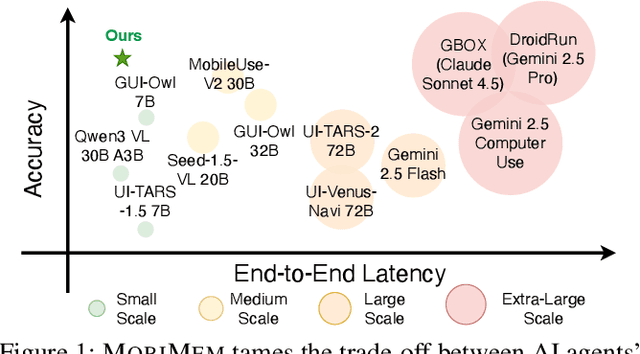
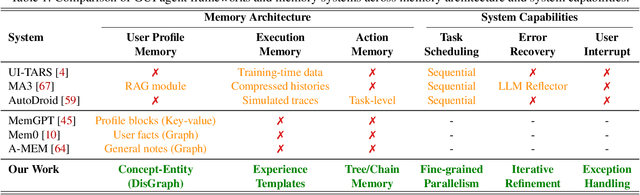
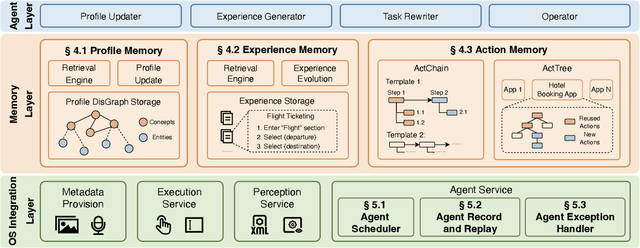
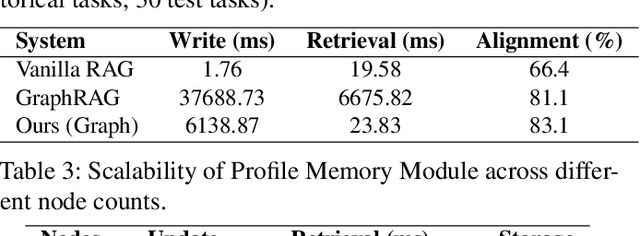
Large Language Model (LLM) agents are increasingly deployed to automate complex workflows in mobile and desktop environments. However, current model-centric agent architectures struggle to self-evolve post-deployment: improving personalization, capability, and efficiency typically requires continuous model retraining/fine-tuning, which incurs prohibitive computational overheads and suffers from an inherent trade-off between model accuracy and inference efficiency. To enable iterative self-evolution without model retraining, we propose MOBIMEM, a memory-centric agent system. MOBIMEM first introduces three specialized memory primitives to decouple agent evolution from model weights: (1) Profile Memory uses a lightweight distance-graph (DisGraph) structure to align with user preferences, resolving the accuracy-latency trade-off in user profile retrieval; (2) Experience Memory employs multi-level templates to instantiate execution logic for new tasks, ensuring capability generalization; and (3) Action Memory records fine-grained interaction sequences, reducing the reliance on expensive model inference. Building upon this memory architecture, MOBIMEM further integrates a suite of OS-inspired services to orchestrate execution: a scheduler that coordinates parallel sub-task execution and memory operations; an agent record-and-replay (AgentRR) mechanism that enables safe and efficient action reuse; and a context-aware exception handling that ensures graceful recovery from user interruptions and runtime errors. Evaluation on AndroidWorld and top-50 apps shows that MOBIMEM achieves 83.1% profile alignment with 23.83 ms retrieval time (280x faster than GraphRAG baselines), improves task success rates by up to 50.3%, and reduces end-to-end latency by up to 9x on mobile devices.
Get Experience from Practice: LLM Agents with Record & Replay
May 23, 2025AI agents, empowered by Large Language Models (LLMs) and communication protocols such as MCP and A2A, have rapidly evolved from simple chatbots to autonomous entities capable of executing complex, multi-step tasks, demonstrating great potential. However, the LLMs' inherent uncertainty and heavy computational resource requirements pose four significant challenges to the development of safe and efficient agents: reliability, privacy, cost and performance. Existing approaches, like model alignment, workflow constraints and on-device model deployment, can partially alleviate some issues but often with limitations, failing to fundamentally resolve these challenges. This paper proposes a new paradigm called AgentRR (Agent Record & Replay), which introduces the classical record-and-replay mechanism into AI agent frameworks. The core idea is to: 1. Record an agent's interaction trace with its environment and internal decision process during task execution, 2. Summarize this trace into a structured "experience" encapsulating the workflow and constraints, and 3. Replay these experiences in subsequent similar tasks to guide the agent's behavior. We detail a multi-level experience abstraction method and a check function mechanism in AgentRR: the former balances experience specificity and generality, while the latter serves as a trust anchor to ensure completeness and safety during replay. In addition, we explore multiple application modes of AgentRR, including user-recorded task demonstration, large-small model collaboration and privacy-aware agent execution, and envision an experience repository for sharing and reusing knowledge to further reduce deployment cost.
The Tenth NTIRE 2025 Efficient Super-Resolution Challenge Report
Apr 14, 2025This paper presents a comprehensive review of the NTIRE 2025 Challenge on Single-Image Efficient Super-Resolution (ESR). The challenge aimed to advance the development of deep models that optimize key computational metrics, i.e., runtime, parameters, and FLOPs, while achieving a PSNR of at least 26.90 dB on the $\operatorname{DIV2K\_LSDIR\_valid}$ dataset and 26.99 dB on the $\operatorname{DIV2K\_LSDIR\_test}$ dataset. A robust participation saw \textbf{244} registered entrants, with \textbf{43} teams submitting valid entries. This report meticulously analyzes these methods and results, emphasizing groundbreaking advancements in state-of-the-art single-image ESR techniques. The analysis highlights innovative approaches and establishes benchmarks for future research in the field.